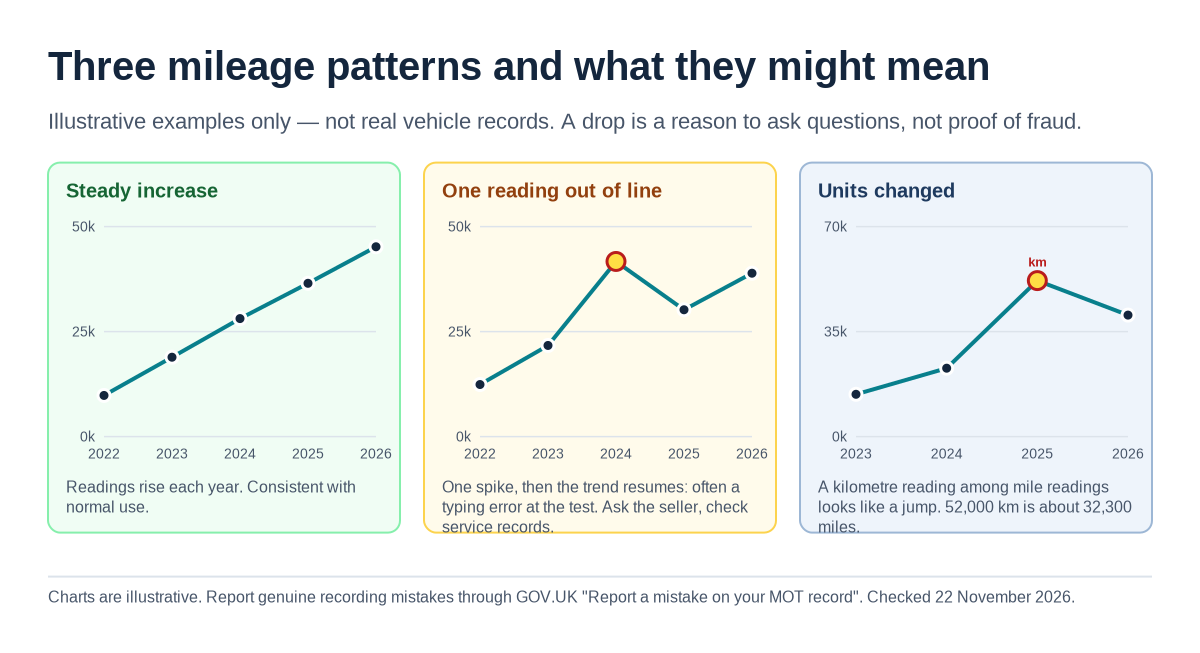
A mileage reading that goes down between MOT tests is a reason to investigate, not proof of fraud. MOT records show the odometer reading entered at each test. Readings can look wrong because of a keying error, a reading recorded in kilometres instead of miles, or a replaced instrument cluster. Check other evidence, such as service records and invoices, before drawing any conclusion.
What the MOT mileage record shows
GOV.UK's MOT history service shows the mileage recorded when the vehicle was tested. The DVSA data includes the reading, its unit (miles or kilometres) and whether the odometer could be read. Our MOT mileage check plots readings in their recorded unit and flags any reading lower than the previous one in the same unit.
Common patterns

| Pattern | Possible innocent explanation | What to check |
|---|---|---|
| One reading far out of line, then the trend resumes | A typing error at the test (for example a transposed digit) | Service records, previous and next readings |
| A sudden "jump" or "drop" | A reading entered in kilometres instead of miles, or the reverse | The unit recorded for each test |
| Readings stop increasing, then continue | An instrument cluster replaced and not recorded properly | Invoices for the replacement and any documentation |
| Mileage marked unreadable | The odometer could not be read, for example due to a fault | The repair history |
We never label a vehicle as "clocked". A drop is a reason to ask the seller questions and look for documents. If you are buying, consider an independent inspection.
How to investigate before buying
- Look at the whole history. A single anomaly between consistent readings is often a recording error.
- Check the units. Our tool shows the unit for each reading and does not compare across different units.
- Ask the seller. A genuine explanation usually comes with paperwork.
- Compare service records. Service invoices with mileages should fit the MOT trend.
- Look at wear. Very worn pedals, seats or steering wheel on a low-mileage car may prompt more questions.
Advisories can also help: repeated wear-related advisories may fit higher use. See MOT advisories explained.
Reporting a mistake on your own vehicle's record
If you own the vehicle and an MOT reading is wrong, use GOV.UK's report a mistake on your MOT record service. Keep evidence, such as a photograph of the odometer and service invoices. Our guide on how long an MOT takes to update online explains how records reach the database.
Converting units
One kilometre is about 0.621 miles, so 52,000 km is about 32,300 miles. When a single reading is in a different unit, convert it before judging the trend — but remember the record itself keeps the unit the tester entered.
Related checks
A history check shows each test in date order with its mileage, and our guide to MOT certificates explains how to compare a paper certificate with the live record.
Questions people also ask
Does a lower reading prove the car has been clocked?
No. A lower reading is a reason to ask questions and look for evidence. Recording errors, unit mix-ups and replaced instrument clusters can all produce one.
Can MOTDueDate tell me the true mileage?
No. We show the readings recorded at each MOT, in the unit recorded. We cannot verify what happened between tests.
Sources
Facts in this guide were checked against these official pages on the dates shown. Rules can change; follow the links for the latest version.
- Check MOT history (GOV.UK) — reviewed 22 November 2026
- Report a mistake on your MOT record (GOV.UK) — reviewed 22 November 2026
- MOT History API documentation (DVSA) — reviewed 22 November 2026