Results & vehicle history
MOT Advisories Explained: Meaning, Codes and Next Steps
How advisories differ from minor, major and dangerous defects, and what to do about each one.

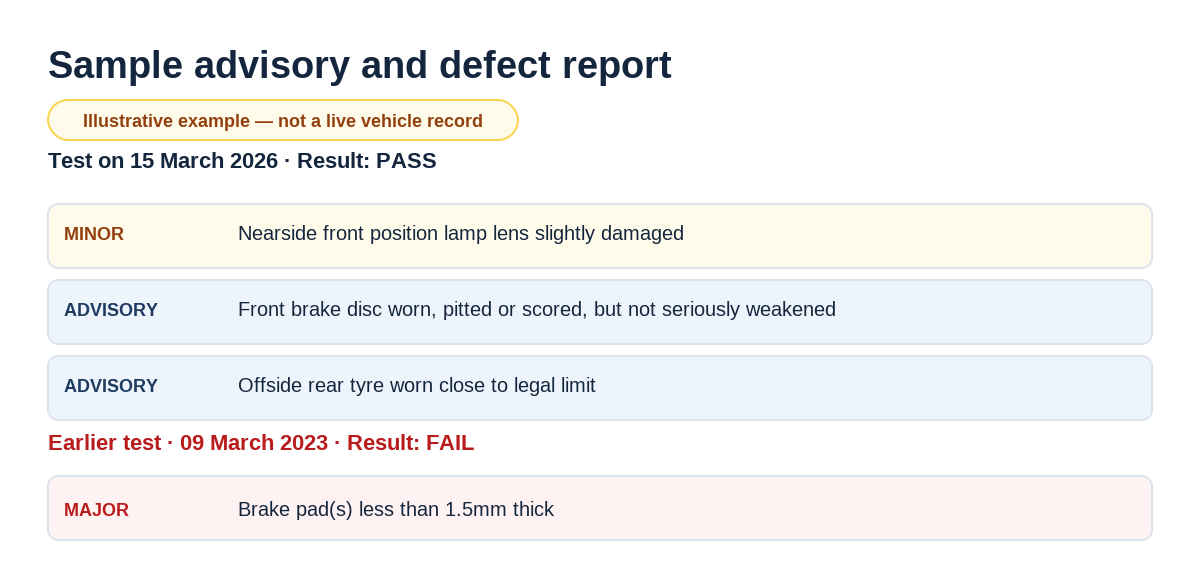
See the advisories and defects recorded at each MOT, grouped by test, in the exact category and wording the tester used.
Free. No account needed. Data from the DVSA MOT History API.
Each item is labelled with its recorded category. We do not reword or re-grade anything: a minor defect stays minor, and an advisory stays an advisory.

| Recorded as | Effect |
|---|---|
| Dangerous | Fail. Must not be driven until repaired. |
| Major | Fail. Repair and retest. |
| Minor | Pass. Repair as soon as possible. |
| Advisory | Pass. Monitor the item. |
Older records (before May 2018 in Great Britain) may use earlier labels such as "fail" rather than "major". We show whichever label is recorded.
Advisories describe what a tester saw on the day, without dismantling the vehicle. A part with no advisory can still wear out, and an advisory does not tell you how long a part will last. For the meaning of each category and next steps, read MOT advisories explained.
Testers choose standard descriptions linked to the inspection manual and can add their own notes. We show the wording exactly as recorded.
Yes, for any test in the record. Advisories are listed under the test where they were recorded.
No. Advisories are notes and do not cause a fail on their own. Major and dangerous defects cause a fail.
How advisories differ from minor, major and dangerous defects, and what to do about each one.
What a fail means, whether you can drive away, repairs and retests, common failure reasons and appeals.
Discs, pads, hoses, performance tests and warning lamps — what testers inspect and what you can check.

Legal tread depths by vehicle type, damage that fails the test, and how to check your own tyres.