An MOT advisory is a note from the tester about something that is not bad enough to be a defect yet but should be monitored or repaired soon. A vehicle can pass with advisories. They are different from minor, major and dangerous defects, which are formal categories with set consequences: major and dangerous defects fail the test, and minor defects do not.
The four categories in an MOT result
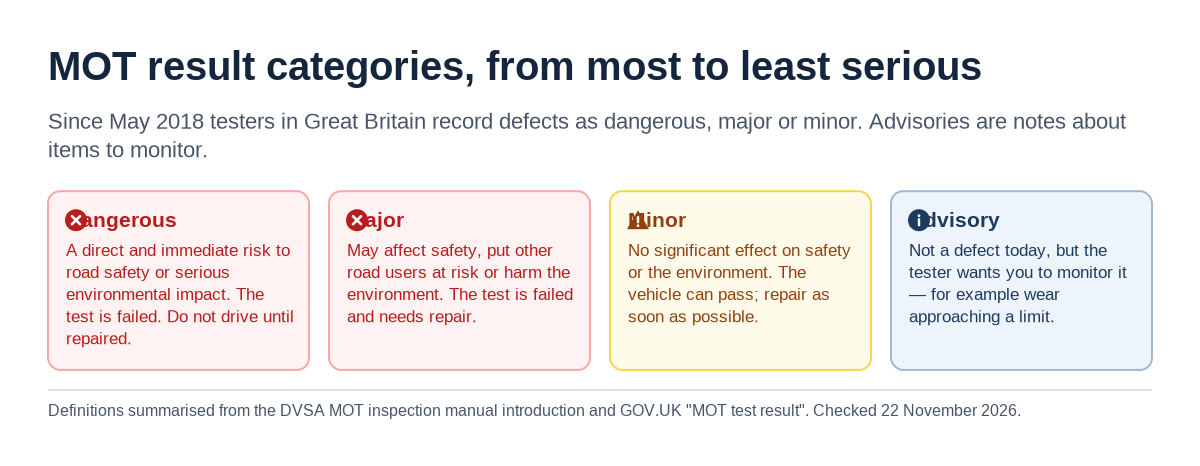
Since 20 May 2018, testers in Great Britain record defects in three categories, and can also add advisory notes. The DVSA inspection manual describes them like this:
| Category | What it means | Test result | What to do |
|---|---|---|---|
| Dangerous | A direct and immediate risk to road safety, or a serious impact on the environment | Fail | Do not drive until repaired |
| Major | May affect the vehicle's safety, put other road users at risk or affect the environment | Fail | Repair, then retest |
| Minor | No significant effect on safety or the environment | Pass | Repair as soon as possible |
| Advisory | Not yet a defect, but the tester wants you to be aware of it | Pass | Monitor, and have it checked |

The tester's wording is recorded alongside each item — for example "Front brake disc worn, pitted or scored, but not seriously weakened". When you check advisories with our tool, we show each item in the category the tester recorded, without reclassifying it.
Common examples of advisories
Advisories most often relate to parts that wear gradually. Typical examples include:
- Tyres worn close to the legal limit, or slight cracking in the sidewall. See our tyres guide.
- Brakes: discs slightly worn or pitted, pads wearing thin. See brake checks.
- Corrosion that is visible but not yet weakening a prescribed area.
- Suspension: a gaiter or bush beginning to deteriorate.
- Oil leaks that are present but not excessive.
Can you drive with MOT advisories?
Yes, if the vehicle passed. An advisory does not stop you using the vehicle. However, you must keep the vehicle roadworthy at all times, not just on test day. An advisory on worn tyres, for example, can become an illegal tyre within a few weeks of heavy driving.
A pass with advisories means the vehicle met the standard when it was inspected. It does not mean every advised item will last until the next test.
What to do about an advisory
- Read the exact wording. The text usually names the part and its condition.
- Prioritise safety-related items. Tyres, brakes, steering and suspension come first.
- Get a professional opinion. A garage can tell you how long a part is likely to last.
- Re-check before the next test. Last year's advisories are a frequent reason for this year's failures. Our MOT checklist can help.
Advisories when buying a used car
The advisory history is one of the most useful parts of an MOT record for a buyer. Look for:
- Repeated advisories for the same part over several years, which may suggest it has never been repaired.
- Advisories followed by a failure for the same item.
- Corrosion advisories on older vehicles, which can be expensive to put right.
Remember that an MOT record shows what testers saw on test days. It is not a service history and does not show work done between tests.
Advisories versus failures
If a test lists any major or dangerous defects, the vehicle has failed, even if it also has advisories. Our guide to what happens if your car fails its MOT explains the next steps, including when you can and cannot drive it.
Questions people also ask
Do advisories mean my car failed?
No. A car can pass with advisories. They are notes from the tester about items to keep an eye on.
Is there an official list of MOT advisory codes?
Advisories are not published as a separate public code list. Testers choose wording linked to the inspection manual's sections, and the public record shows that text rather than a numeric code.
Can a seller remove advisories from the record?
No. Advisories form part of the MOT record held by DVSA and appear in the history for that test.
Sources
Facts in this guide were checked against these official pages on the dates shown. Rules can change; follow the links for the latest version.
- MOT inspection manual: introduction (GOV.UK) — reviewed 22 November 2026
- MOT test result (GOV.UK) — reviewed 22 November 2026
- Check MOT history (GOV.UK) — reviewed 22 November 2026