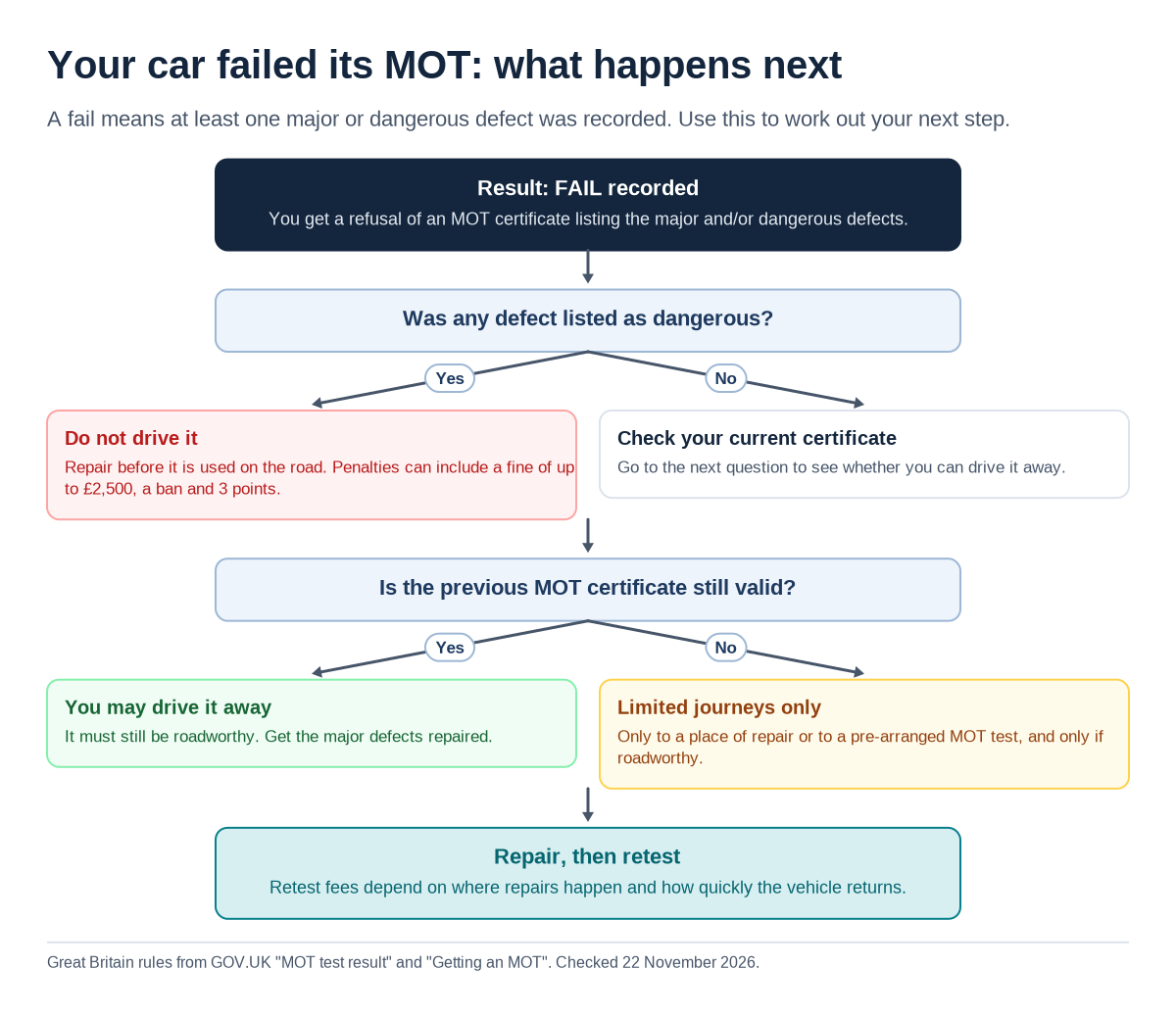

A car fails its MOT when the tester records at least one major or dangerous defect. The result is entered in the MOT database straight away, and you receive a refusal of an MOT certificate listing the problems. Whether you can drive the car away depends on two things: whether any defect is dangerous, and whether your previous certificate is still valid. After repairs, the vehicle needs a retest.
What an MOT failure means
The MOT has three defect categories. Minor defects do not cause a failure. Major and dangerous defects do:
- Major: may affect safety, put other road users at risk or harm the environment. The vehicle fails and must be repaired.
- Dangerous: a direct and immediate risk to road safety or a serious impact on the environment. The vehicle fails, and must not be driven until it is repaired.
Your result may also include minor defects and advisories. Our advisories guide explains how they differ.
Can you drive a car that has failed its MOT?
GOV.UK says you can only drive the vehicle away if your current MOT certificate is still valid and no dangerous problems were listed. If the certificate has expired, you can only drive to have the defects fixed or to a pre-arranged MOT test. In every case the vehicle must still meet minimum roadworthiness standards.

The penalties for driving with a dangerous defect are serious: GOV.UK lists a fine of up to £2,500, a driving ban and 3 penalty points. Our guide can you drive a car after a failed MOT? covers this decision in detail.
Even if your previous certificate runs for weeks yet, a dangerous defect recorded at a new test means the vehicle should not be driven until repaired.
Repairs: where and when
You do not have to have repairs done at the centre that tested the vehicle. You can:
- leave it at the test centre for repair;
- take it to another garage, subject to the driving rules above; or
- do the work yourself if you are competent to do it safely.
Ask for a written quote before agreeing to repairs, and keep receipts.
Retesting after a failure
Once repairs are done, the vehicle needs a retest. The type of retest and whether you pay depend on where it was repaired and how soon it returns. Leaving it at the test centre for repair and having it retested within 10 working days means a partial retest with no fee. Our MOT retest guide explains all the options.
What commonly fails an MOT?
DVSA publishes detailed failure data separately, but the categories that commonly cause failures are easy to check in advance:
| Area | Typical failure reasons |
|---|---|
| Lighting and signalling | Blown bulbs, incorrect headlamp aim, damaged lenses |
| Suspension | Broken springs, worn joints, leaking shock absorbers |
| Brakes | Worn pads or discs, low efficiency, warning lamp lit |
| Tyres | Tread below the legal limit, cuts, bulges |
| Visibility | Windscreen damage in the driver's view, worn wipers |
A pre-MOT checklist catches many of these. The MOT history check shows what failed on previous tests for any vehicle.
Appealing an MOT failure
If you think a fail is wrong, GOV.UK says to discuss it with the test centre before any repairs start, then send DVSA's complaint form within 14 working days of the test. GOV.UK also says you should not have repairs made until the appeal has finished, because DVSA may recheck the vehicle. If DVSA rechecks it you pay the full test fee again, which is refunded if the appeal succeeds. If the result is right but details on the record are wrong — for example the mileage — use the report a mistake on your MOT record service instead.
Northern Ireland
DVA carries out tests at its own centres. nidirect says an application for a retest must be made within 21 days of the original test and completed within 60 days. Check nidirect for current guidance on driving after a fail.
Questions people also ask
Does a failed MOT cancel my current certificate?
A fail is recorded straight away, but if your previous certificate has not yet expired you can still drive the vehicle as long as there are no dangerous defects and it remains roadworthy.
Will a fail show up in the MOT history?
Yes. Both fails and passes are recorded in the MOT database and appear in the vehicle's public MOT history.
Sources
Facts in this guide were checked against these official pages on the dates shown. Rules can change; follow the links for the latest version.
- MOT test result (GOV.UK) — reviewed 22 November 2026
- Retest after a repair (GOV.UK) — reviewed 22 November 2026
- Test result appeals and problems (GOV.UK) — reviewed 22 November 2026
- MOT inspection manual: introduction (GOV.UK) — reviewed 22 November 2026