Dates & rules
How Early Can You Get an MOT?
Test up to a month (minus a day) early and keep your renewal date — with worked calendar examples.

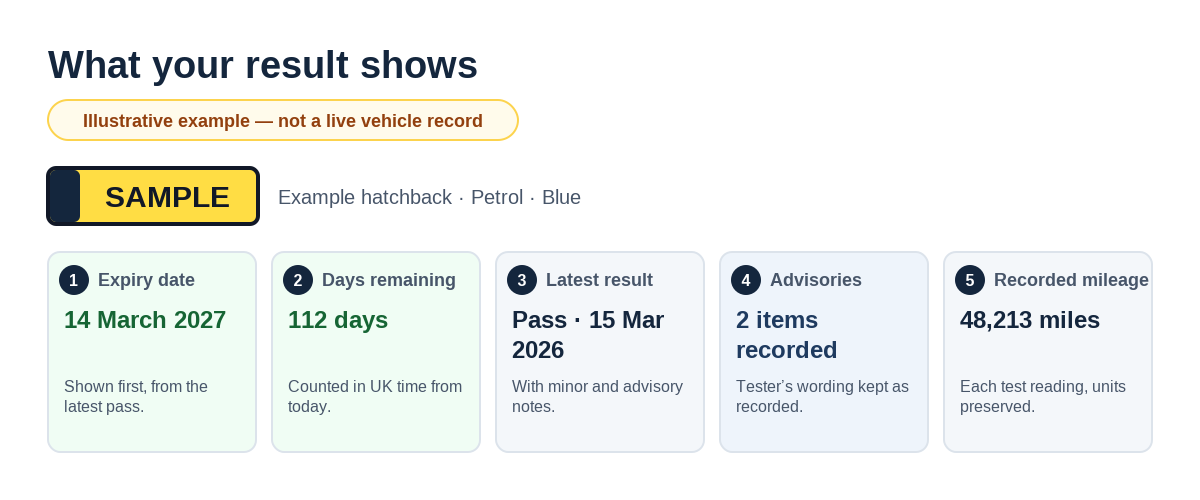
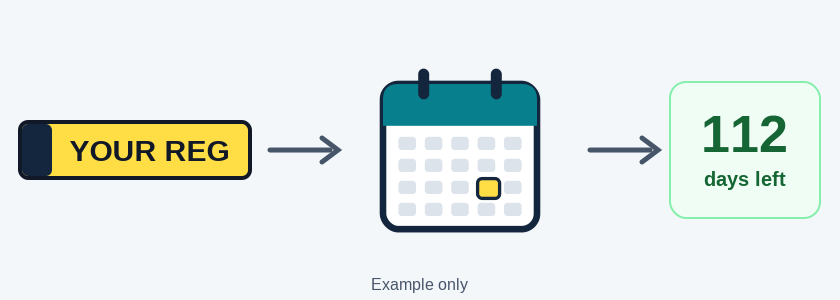
Enter a registration number to see the MOT expiry date and how many days are left, followed by the full test history, advisories and recorded mileage.
Free. No account needed. Data from the DVSA MOT History API.
The due date comes first, because that is what most people need. Everything else is underneath, in the order you are likely to read it.

Type the number plate. Spaces and lower-case letters are fine; we tidy them up.
Your registration is sent securely to the DVSA MOT History API and the record comes back in seconds.
See the expiry date and days left first, then the history, advisories and mileage below.
MOTDueDate shows the MOT information DVSA makes available through its API. That covers cars, motorcycles and vans tested in Great Britain since 2005, heavier vehicles in Great Britain since 2018, and tests in Northern Ireland since 2017.
Each result shows when it was retrieved. We do not keep a history of the registrations you search, and we do not put them in page addresses or share links.
An MOT lasts a year. In Great Britain most cars, motorcycles and vans need their first test by the third anniversary of registration, then every year after that. Taxis, ambulances and passenger vehicles with nine or more seats need one from a year old. In Northern Ireland, cars and motorcycles are generally first tested at four years old.
You do not have to wait until the last minute. In Great Britain you can have the test up to a month (minus a day) before the expiry date and keep the same renewal date. For example, if your MOT runs out on 15 May, the earliest test that keeps that date is 16 April.
Read more in how early can you get an MOT? and when is a car's first MOT due?
Once the expiry date has passed, you can only drive to a pre-arranged MOT test or to a place of repair. GOV.UK says the fine for driving without a valid MOT can be up to £1,000. See the rules.
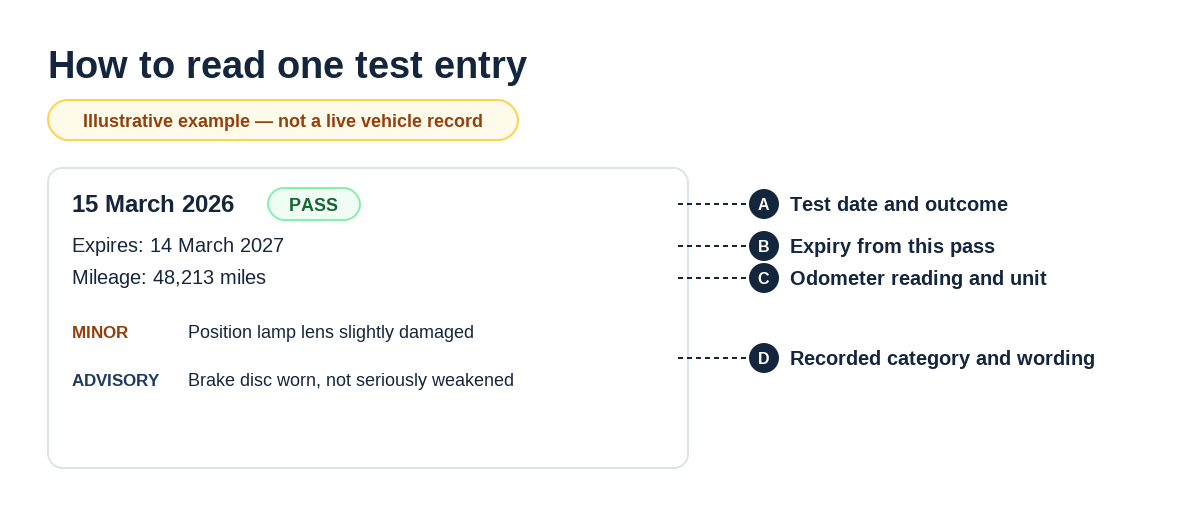
Every test entry has a date, a result, an expiry date if it passed, a mileage reading and a list of anything the tester noted. Testers in Great Britain record problems in three categories, plus advisories:
| Category | Result | What it means |
|---|---|---|
| Dangerous | Fail | Direct and immediate risk. Do not drive until repaired. |
| Major | Fail | Must be repaired and retested. |
| Minor | Pass | Repair as soon as possible. |
| Advisory | Pass | Monitor; may need work before next year. |
A fail followed by a pass on the same or next day usually means the vehicle was repaired and retested. Look for the same advisory appearing year after year — it may never have been fixed. MOT advisories explained.

| Record | Who holds it | What it tells you | Shown here? |
|---|---|---|---|
| MOT | DVSA (GB) and DVA (NI) test records | Whether the vehicle met minimum standards on each test day, and when the next test is due | Yes |
| Vehicle tax | DVLA | Whether the vehicle is taxed or declared off the road (SORN) | No — check on GOV.UK |
| Insurance | Insurers and the Motor Insurance Database | Whether the vehicle is insured to be driven | No — the DVSA API does not include insurance |
| Service history | Owner, garages and dealers | Maintenance work between tests | No |
A vehicle can have a valid MOT and still be untaxed or uninsured, and a valid MOT does not prove a used car is a safe purchase. Read what is an MOT? for more.
Every recorded test in date order, with pass and fail outcomes.
Advisories and defects recorded at each test, as written by the tester.
Odometer readings from each test plotted over time, with units kept.
Expiry and history for motorcycles, scooters and mopeds.
Rules, costs, results and component checks, each linked to official sources.
Test up to a month (minus a day) early and keep your renewal date — with worked calendar examples.
The two journeys allowed without a valid MOT, the fine, and the knock-on effects for tax and insurance.
What a fail means, whether you can drive away, repairs and retests, common failure reasons and appeals.

How advisories differ from minor, major and dangerous defects, and what to do about each one.

Legal maximum fees for cars, motorcycles and vans in Great Britain, DVA fees in Northern Ireland, and why quotes vary.
What the MOT inspects, simple checks you can do yourself in ten minutes, and a printable checklist.
Results come from the DVSA MOT History API at the moment you search, and each one shows the time it was retrieved. MOT data contains public sector information licensed under the Open Government Licence v3.0.
MOTDueDate is independent. Having access to the API does not mean DVSA, DVLA or DVA endorse this site. Our guides are written in plain English and checked against GOV.UK, nidirect and the DVSA inspection manuals — see our data sources and editorial policy. If you spot a mistake in an MOT record itself, use the official report a mistake service.
Yes. Checking an MOT due date or history on MOTDueDate is free and needs no account. We do not sell reports.
From the DVSA MOT History API, the official source of MOT test records for vehicles in Great Britain and Northern Ireland. We request the record when you search. See data sources.
Yes. MOT history is public information that anyone can look up with a registration number, which is why buyers use it. It does not include the keeper’s name or address.
Some records have no tests or no expiry date, for example because the vehicle is new, recently imported or exempt. Missing data does not by itself prove any of those, so we say so rather than guessing.
No. A valid MOT means the vehicle met the minimum standard on the test day. The vehicle must also be roadworthy, taxed and insured to be used on the road.
No. We show the record, but certificates come from official services. Use GOV.UK for Great Britain, or nidirect for Northern Ireland.
Free. No account needed. Data from the DVSA MOT History API.