The MOT checks that your vehicle meets legal road safety and environmental standards on the day of the test. It covers lights, tyres, brakes, steering, suspension, visibility, seatbelts, the body structure, exhaust emissions and more. It does not check the condition of the engine, clutch or gearbox. Many failures are caused by simple faults, such as a blown bulb, that you can find yourself in a few minutes.
What the MOT test covers
The DVSA inspection manual for cars and passenger vehicles is organised into sections. In plain terms, a tester looks at:
| Area | Examples of what is inspected |
|---|---|
| Identification | Registration plates and the vehicle identification number (VIN) |
| Brakes | Condition, performance, warning lamps — see our brakes guide |
| Steering | Steering wheel, column, joints and power steering — see suspension and steering |
| Visibility | Windscreen, wipers, washers and mirrors — see lights and visibility |
| Lamps and electrics | Headlamps and aim, stop lamps, indicators, battery and wiring |
| Axles, wheels, tyres, suspension | Tread depth, tyre condition, springs and shock absorbers — see tyres |
| Body, structure and attachments | Corrosion near key mounting points, doors, seats, fuel system |
| Other equipment | Seatbelts, horn, speedometer, airbags and warning lamps where required |
| Nuisance | Exhaust emissions, smoke and leaks — see emissions |
The exact checks depend on the vehicle's age and class. The test is carried out without dismantling parts.
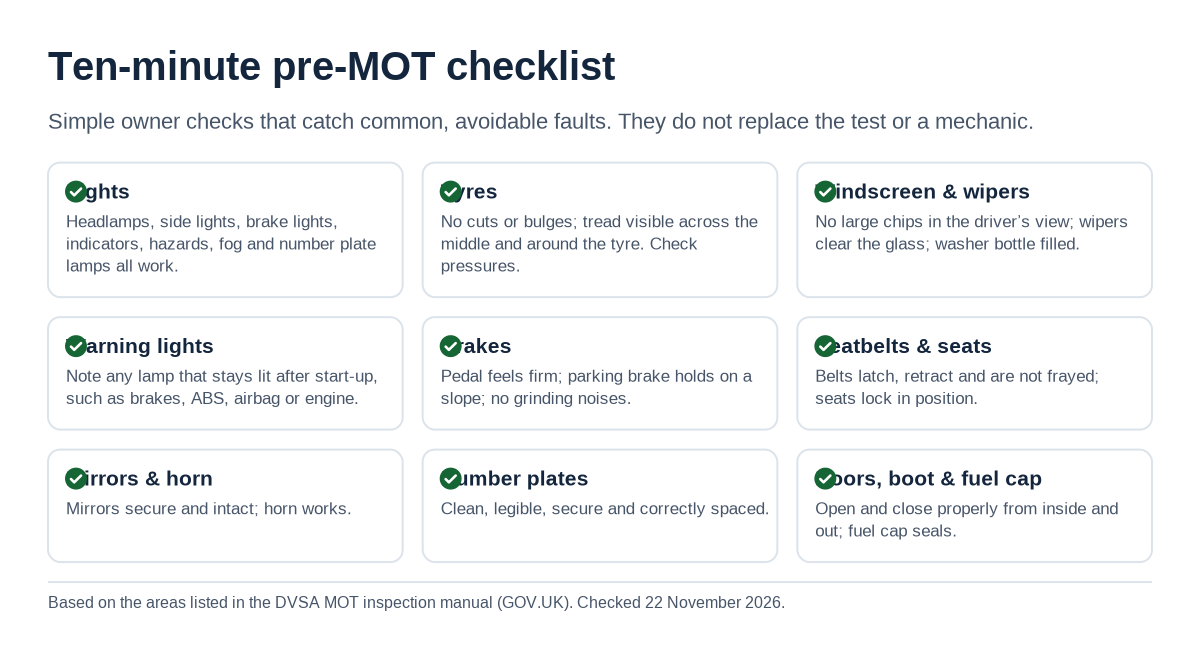
A ten-minute pre-MOT checklist
These checks will not tell you whether the car will pass, but they catch faults that cause avoidable failures. Do them a few days before the test so there is time to fix anything you find.

Lights and electrics
- Switch on side lights, dipped and main beam headlamps, and check each one.
- Ask someone to watch the brake lights while you press the pedal, including the high-level brake light.
- Check front, rear and side indicators and the hazard warning lights.
- Check the rear fog lamp and the number plate lamp.
Tyres and wheels
- Look for cuts, bulges or exposed cords on the sidewalls and tread.
- Check that tread is visible across the middle of the tyre and all the way round. Cars need at least 1.6mm across the central three-quarters.
- Set pressures to the figures in the handbook or on the door pillar.
Visibility
- Look for chips or cracks in the windscreen, especially in the area directly in front of the driver.
- Make sure the wipers clear the screen without smearing and the washer bottle is filled.
- Check that the mirrors are secure and not cracked.
Inside the car
- Start the engine and note any warning light that stays on, such as brakes, ABS, airbag or engine management.
- Pull each seatbelt out fully, check it latches and retracts, and look for fraying.
- Check the horn works and that the driver's seat locks in position.
Outside the car
- Clean the number plates and check the characters are correct, legible and properly spaced.
- Check the doors open from inside and out, the boot and bonnet close securely, and the fuel cap seals.
Owner checks are for spotting problems. Brakes, steering, suspension and structural repairs should be done by someone competent to do them.
Check last year's advisories first
Advisories are notes about parts that were wearing but had not yet reached the point of failure. A year later, those same parts are a common reason for failing. Use the MOT advisory checker to see what was recorded at the last test, then have those items inspected before the next one. Our advisories guide explains what each category means.
On the day
- Remove clutter from the boot and cabin so the tester can reach seatbelts and the spare wheel well.
- Take the locking wheel nut key if the car has one.
- Make sure there is enough fuel and oil for the emissions test.
- You can watch from a viewing area at many centres, but GOV.UK says you are not allowed to interrupt the tester.
Printable version
Use your browser's print option on this page. The site header, menus and checker are hidden in print, leaving the checklist and tables.
If the car does fail, our guide to what happens after a failed MOT explains your options.
Questions people also ask
Can I be refused a test if the car is dirty or full of clutter?
A test centre can refuse to test a vehicle in some circumstances, for example if it is so dirty or loaded that parts cannot be inspected. Clearing the boot and cabin avoids that risk.
Does the MOT check the engine or gearbox?
No. GOV.UK says the test does not cover the condition of the engine, clutch or gearbox. A service is the place for those.
Sources
Facts in this guide were checked against these official pages on the dates shown. Rules can change; follow the links for the latest version.
- MOT inspection manual: cars and passenger vehicles (GOV.UK) — reviewed 22 November 2026
- How the MOT test works (GOV.UK) — reviewed 22 November 2026
- Check your vehicle is safe to drive (GOV.UK) — reviewed 22 November 2026