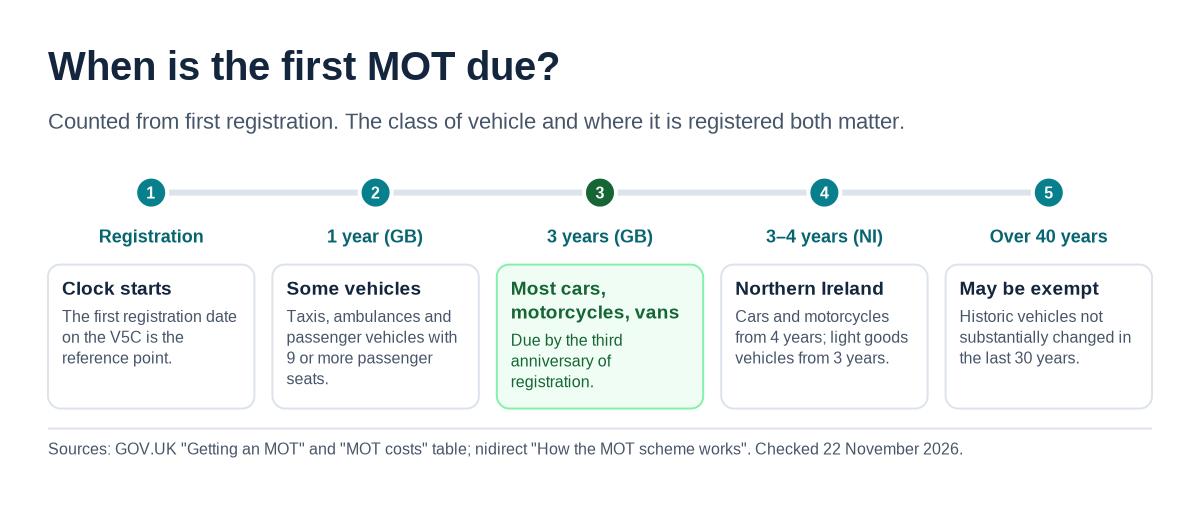

In Great Britain most cars, motorcycles and light vans need their first MOT by the third anniversary of their registration. Some vehicles, including taxis, ambulances and passenger vehicles with nine or more passenger seats, need one from one year old. In Northern Ireland, cars and motorcycles are generally first tested at four years old and light goods vehicles at three. After the first test, an MOT is needed every year.
First MOT ages at a glance

| Vehicle | Great Britain | Northern Ireland |
|---|---|---|
| Private cars | By the 3rd anniversary of registration | Generally from 4 years old |
| Motorcycles | By the 3rd anniversary | Generally from 4 years old |
| Light goods vehicles (up to 3,500kg) | 3 years (class 4 up to 3,000kg; class 7 above) | Before the end of the month, 3 years after first registration |
| Taxis and ambulances | 1 year | Check nidirect |
| Passenger vehicles with 9+ passenger seats | 1 year | Check nidirect |
GB first-test ages come from GOV.UK's fee table. Northern Ireland information is from nidirect.
How to work out your vehicle's date
- Find the date of first registration on the V5C log book.
- Add three years (or the age for your vehicle type).
- Book the test before that date. In Great Britain you can test up to a month (minus a day) early and still keep the anniversary as your renewal date — see how early can you get an MOT.
A car first registered on 1 September 2023 in England needs its first MOT by 1 September 2026. Booking the test in the month before that date keeps the September anniversary as the renewal date; testing much earlier would move the renewal date forward.
Imported and older vehicles
For imported vehicles the "first used" date can differ from the UK registration date. The MOT inspection manual explains that testers use the date of manufacture for some imports and the earlier of the first registration date or six months after manufacture in other cases. If you are unsure, the MOT checker shows what DVSA holds.
Very old vehicles may not need an MOT at all. Read MOT exemption for the 40-year rule.
What our checker shows for new vehicles
If a vehicle has no tests on record, DVSA's data sometimes includes a first MOT due date, and we show it when it is supplied. If neither tests nor a due date are recorded, we say so plainly rather than guessing. That situation does not, on its own, mean the vehicle is exempt or that its first MOT is not yet due.
Missing your first MOT
The first MOT is easy to forget because there is no previous certificate to remind you. Driving without a valid MOT once it is due can lead to a fine of up to £1,000. See driving without an MOT, and sign up for free GOV.UK MOT reminders.
For more on the test itself, read what is an MOT?
Questions people also ask
Is the first MOT due exactly three years from the date I bought the car?
No. It is based on the date of first registration, not the date you bought it. For a used car, check the V5C log book or the MOT checker.
My new car shows no MOT history. Is that a problem?
Not if it has not reached its first test age. DVSA's record may show a first MOT due date. No history does not by itself mean a vehicle is exempt.
Sources
Facts in this guide were checked against these official pages on the dates shown. Rules can change; follow the links for the latest version.
- Getting an MOT (GOV.UK) — reviewed 22 November 2026
- MOT costs: fee table with first-test ages (GOV.UK) — reviewed 22 November 2026
- How the MOT scheme works (nidirect) — reviewed 22 November 2026