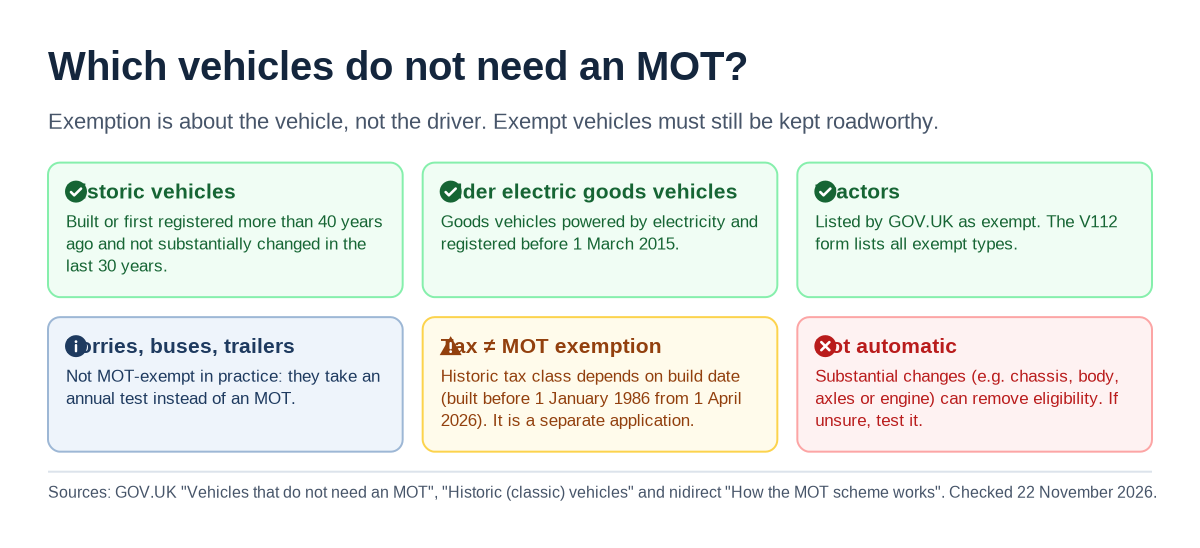

Most vehicles need an MOT once they reach their first test age, but some are exempt. The main exemption is for historic vehicles: in Great Britain, a vehicle does not need an MOT if it was built or first registered more than 40 years ago and has not been substantially changed in the last 30 years. GOV.UK also lists goods vehicles powered by electricity registered before 1 March 2015, and tractors. An exempt vehicle must still be kept roadworthy.
Vehicles that do not need an MOT

| Vehicle | Exempt? | Notes |
|---|---|---|
| Historic vehicles over 40 years old | Yes, if conditions are met | Not substantially changed in the last 30 years |
| Electric goods vehicles registered before 1 March 2015 | Yes | Listed by GOV.UK |
| Tractors | Yes | Listed by GOV.UK |
| Lorries, buses and trailers | Not MOT-tested | They need an annual test instead of an MOT |
| Other types | Check form V112 | GOV.UK says the full list is on the MOT exemption form (V112) |
The 40-year historic vehicle rule
GOV.UK's exemption criteria say a vehicle does not need an MOT if:
- it was built or first registered more than 40 years ago; and
- no substantial changes have been made to it in the last 30 years.
Because the 40-year test is measured from today, more vehicles become eligible each year. Vehicles meeting these conditions are called "vehicles of historical interest".
What counts as a substantial change?
GOV.UK gives examples such as replacing the chassis, body, axles or engine in a way that changes how the vehicle works. The full criteria are set out in DVSA's guidance. If you are not sure whether your vehicle has been substantially changed, do not assume it is exempt — test it.
GOV.UK is clear that exempt vehicles must stay in roadworthy condition. You can be prosecuted for using an unroadworthy vehicle whether or not it needs an MOT.
Tax exemption and MOT exemption are different
People often mix up the historic tax class and the MOT exemption. They are separate:
- Vehicle tax: GOV.UK says vehicles built before 1 January 1986 can stop paying vehicle tax from 1 April 2026. If the build date is unknown, a vehicle registered before 8 January 1986 is treated the same way. You must apply for the exemption, which moves the vehicle into the historic tax class.
- MOT: uses the 40-year rule above, plus the substantial-change condition.
A vehicle can qualify for one without the other, so check both. GOV.UK says you do not need to apply for an MOT exemption every year.
What a missing MOT history means
If a vehicle has no tests on record, that does not prove it is exempt. It may be too new for its first test, registered recently from abroad, or simply untested. Our first MOT guide explains test ages, and you can check a vehicle's MOT status to see what DVSA has on record.
Northern Ireland
nidirect says cars, motorcycles and light goods vehicles up to 3,500kg first made or registered over 40 years ago are exempt from annual testing if they have not had major changes in the last 30 years, recorded on form V112. nidirect also says commercial buses and taxis are not exempt, and if you are unsure whether a change is major, you should not claim the exemption.
Using an exempt vehicle
- You can drive it without an MOT certificate, but it must be roadworthy.
- It still needs tax (or a tax exemption) and insurance.
- You can choose a voluntary MOT at any time.
If your vehicle is not exempt and the MOT has run out, read driving without an MOT for the limited journeys allowed.
Questions people also ask
Is my car exempt from the MOT because it is 40 years old?
Only if it was built or first registered more than 40 years ago and has not been substantially changed in the last 30 years. Age alone is not enough.
Can I still MOT an exempt vehicle?
Yes. Owners can choose to have a voluntary test, and many do so as an independent safety check.
Does an exempt vehicle need tax and insurance?
It still needs to be taxed (or placed in a tax-exempt class where it qualifies) and insured to be used on the road. MOT exemption does not change that.
Sources
Facts in this guide were checked against these official pages on the dates shown. Rules can change; follow the links for the latest version.
- Vehicles that do not need an MOT (GOV.UK) — reviewed 22 November 2026
- Historic (classic) vehicles (GOV.UK) — reviewed 22 November 2026
- Historic (classic) vehicles: MOT exemption criteria (GOV.UK) — reviewed 22 November 2026
- How the MOT scheme works (nidirect) — reviewed 22 November 2026