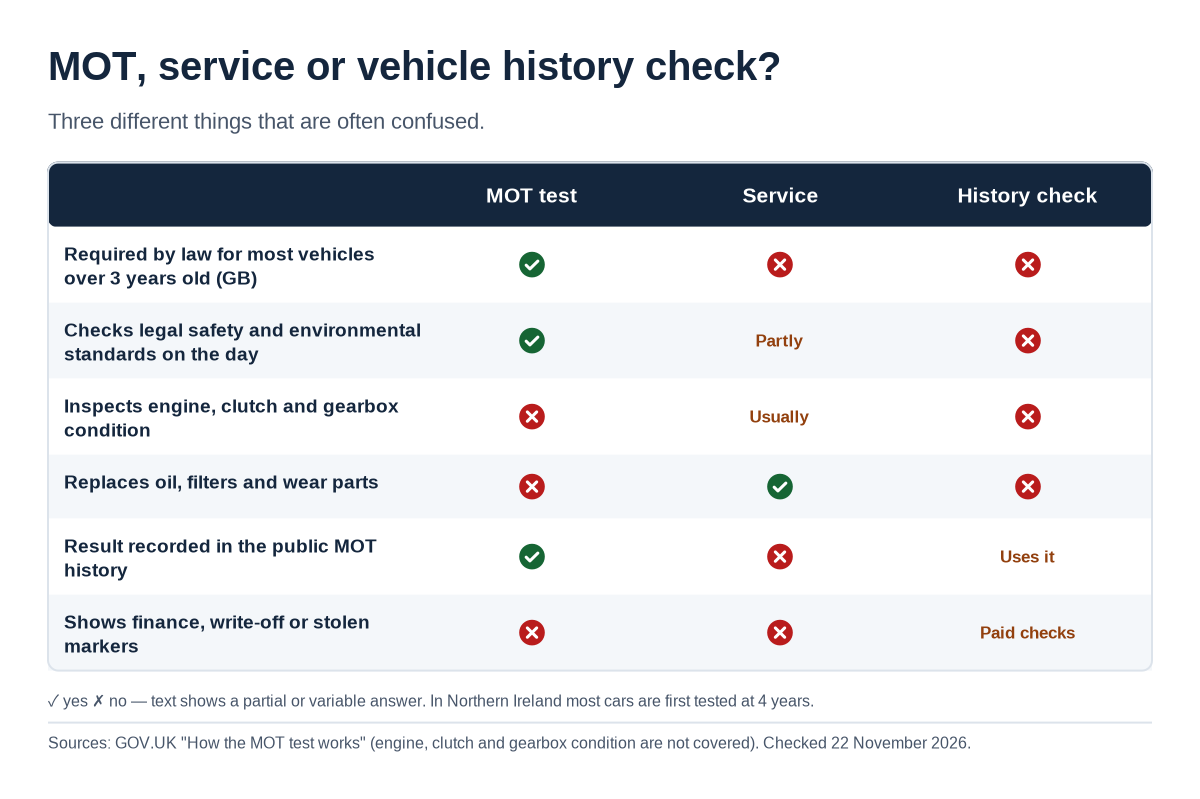
The MOT is an annual test of a vehicle's safety, roadworthiness and exhaust emissions, required for most vehicles once they reach a set age. In Great Britain most cars need their first MOT by the third anniversary of registration, then every year. In Northern Ireland cars and motorcycles are generally first tested at four years old. The test checks the vehicle against minimum legal standards on the day; it does not check the condition of the engine, clutch or gearbox.
What the MOT checks
The DVSA inspection manual covers identification, brakes, steering, visibility, lamps and electrics, axles, wheels, tyres and suspension, the body and structure, other equipment such as seatbelts, and emissions ("nuisance"). Our MOT checklist breaks this down, with simple checks you can do yourself.
What the MOT does not check
GOV.UK states that the MOT does not cover the condition of the engine, clutch or gearbox. The test is carried out without dismantling the vehicle, and it does not tell you:
- when the vehicle was last serviced;
- whether there is outstanding finance;
- whether it has been written off or stolen; or
- what it is worth.
MOT, service or history check?

| MOT test | Service | Vehicle history check | |
|---|---|---|---|
| Purpose | Legal minimum safety and environmental standard | Maintenance to the maker's schedule | Background on the vehicle's past |
| Required by law? | Yes, for most vehicles over the test age | No | No |
| Public record | Yes — the MOT history | Service book or garage records | Depends on the provider |
Who runs the MOT?
Several organisations are involved, and their names are easy to mix up:
- DVSA (Driver and Vehicle Standards Agency) sets MOT standards in Great Britain, approves test centres and testers, and runs the MOT database and the MOT History API.
- DVLA (Driver and Vehicle Licensing Agency) handles vehicle registration and tax. It checks the MOT database when you tax a vehicle.
- DVA (Driver & Vehicle Agency) carries out MOT tests in Northern Ireland at its own test centres.
MOTDueDate is independent of all three.
When is an MOT needed?
| Situation | When the test is needed |
|---|---|
| Most cars, motorcycles and vans in Great Britain | By the third anniversary of registration, then yearly |
| Taxis, ambulances and 9+ passenger seat vehicles in GB | From one year old |
| Cars and motorcycles in Northern Ireland | Generally from four years old |
| Historic vehicles over 40 years old | May be exempt if not substantially changed |
See when is a car's first MOT due? and MOT exemption for the detail.
What happens at the test
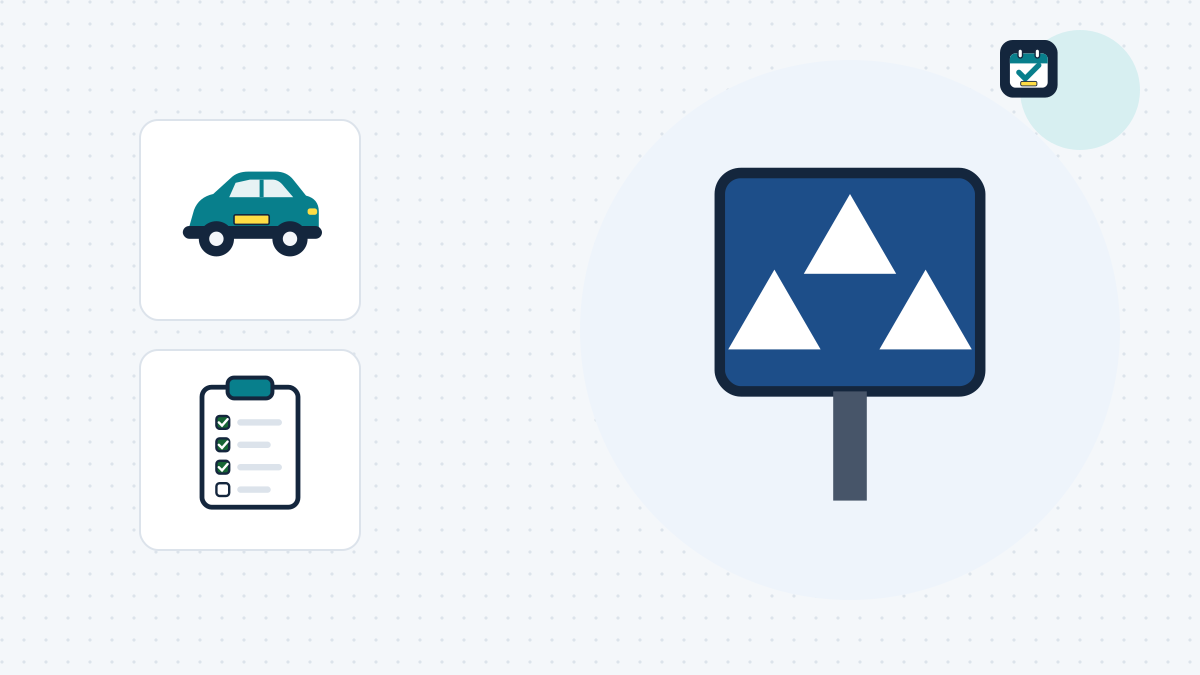
You take the vehicle to an approved test centre. In Great Britain, only centres displaying the blue sign with three white triangles can carry out MOTs. The tester records a pass or fail, with any defects categorised as dangerous, major or minor, plus advisories. The result goes into the MOT database straight away. The MOT cost guide lists the maximum fees.
Ready to check your own vehicle? Find out when your MOT is due.
Questions people also ask
What does MOT stand for?
MOT comes from the Ministry of Transport, the government department that introduced the test. The name stuck even though the department no longer exists in that form.
Does a pass mean my car is safe to drive all year?
No. A pass shows the vehicle met the minimum standard on the day of the test. You must keep it roadworthy at all times.
Sources
Facts in this guide were checked against these official pages on the dates shown. Rules can change; follow the links for the latest version.
- Getting an MOT (GOV.UK) — reviewed 22 November 2026
- How the MOT test works (GOV.UK) — reviewed 22 November 2026
- MOT inspection manual: cars and passenger vehicles (GOV.UK) — reviewed 22 November 2026
- How the MOT scheme works (nidirect) — reviewed 22 November 2026