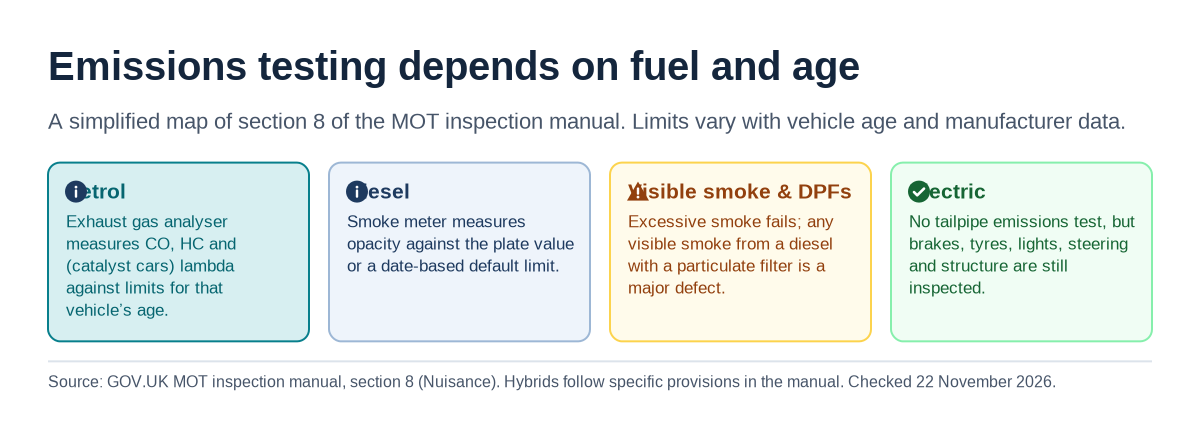
The MOT emissions test depends on the fuel type and age of the vehicle. Petrol vehicles are tested with an exhaust gas analyser that measures carbon monoxide (CO), hydrocarbons (HC) and, for catalyst-equipped cars, lambda. Diesels are tested with a smoke meter that measures smoke opacity. Electric vehicles have no tailpipe test, but every other part of the MOT still applies.
Emissions paths by fuel type

Petrol
The DVSA manual says emissions testing applies to petrol vehicles first used on or after 1 August 1975. A gas analyser measures CO and HC at fast idle and idle, and catalyst-equipped vehicles are also checked for lambda (the air-fuel balance). Limits depend on the vehicle's age and, where available, the manufacturer's data.
Diesel
Diesels first used on or after 1 January 1980 are tested with an approved smoke meter. The limit is the plate value on the vehicle where there is one, otherwise a default that depends on age:
| Diesel first used | Default smoke limit |
|---|---|
| Before 1 July 2008 | 2.5 m⁻¹ (non-turbo) or 3.0 m⁻¹ (turbo) |
| 1 July 2008 to 31 December 2013 | 1.5 m⁻¹ |
| On or after 1 January 2014 | 0.7 m⁻¹ |
Older diesels are checked visually.
Visible smoke and particulate filters
- A petrol vehicle can fail for dense blue or clearly visible black smoke at idle, or excessive smoke on acceleration.
- A diesel can fail with a dangerous defect for smoke or vapour of any colour that could obscure other road users' view.
- Any visible smoke from a diesel fitted with a diesel particulate filter (DPF) is a major defect.
Electric and hybrid
Battery electric vehicles have no exhaust to test. Hybrid vehicles are covered by specific provisions in the inspection manual. In all cases the rest of the MOT applies.
Emission control equipment and warning lamps
For petrol vehicles first used on or after 1 September 2002, the manual says original emission control equipment that is missing, obviously modified or obviously defective is a reason for rejection. The engine malfunction indicator lamp (MIL) is also checked on petrol vehicles first used on or after 1 July 2003 (up to 8 passenger seats) and on diesels first used on or after 1 July 2008.
Removing a DPF or catalytic converter, or disabling emission controls, can cause a fail and may break other laws. If a warning lamp is on, get it diagnosed before the test.
How to prepare
- Make sure the engine has enough oil and fuel; a tester can refuse to test a vehicle that is not fit to be driven.
- Fix any engine warning light before the test.
- For diesels, a regular run on faster roads can help some DPFs regenerate — follow the manufacturer's guidance.
- Check last year's history for emissions-related advisories with the MOT history check.
For a full list of what the test covers, see the MOT checklist and what is an MOT?. If emissions caused a fail, read what happens if your car fails its MOT.
Questions people also ask
Will a removed diesel particulate filter fail the MOT?
Missing or obviously tampered emission control equipment can lead to a failure, and the manual says any visible smoke from a vehicle fitted with a DPF is a major defect.
Does an electric car have an emissions test?
There is no tailpipe emissions test because there is no exhaust, but the rest of the MOT — brakes, tyres, lights, steering, suspension and structure — still applies.
Sources
Facts in this guide were checked against these official pages on the dates shown. Rules can change; follow the links for the latest version.
- MOT inspection manual: section 8, nuisance (GOV.UK) — reviewed 22 November 2026
- How the MOT test works (GOV.UK) — reviewed 22 November 2026
- MOT inspection manual: introduction (GOV.UK) — reviewed 22 November 2026