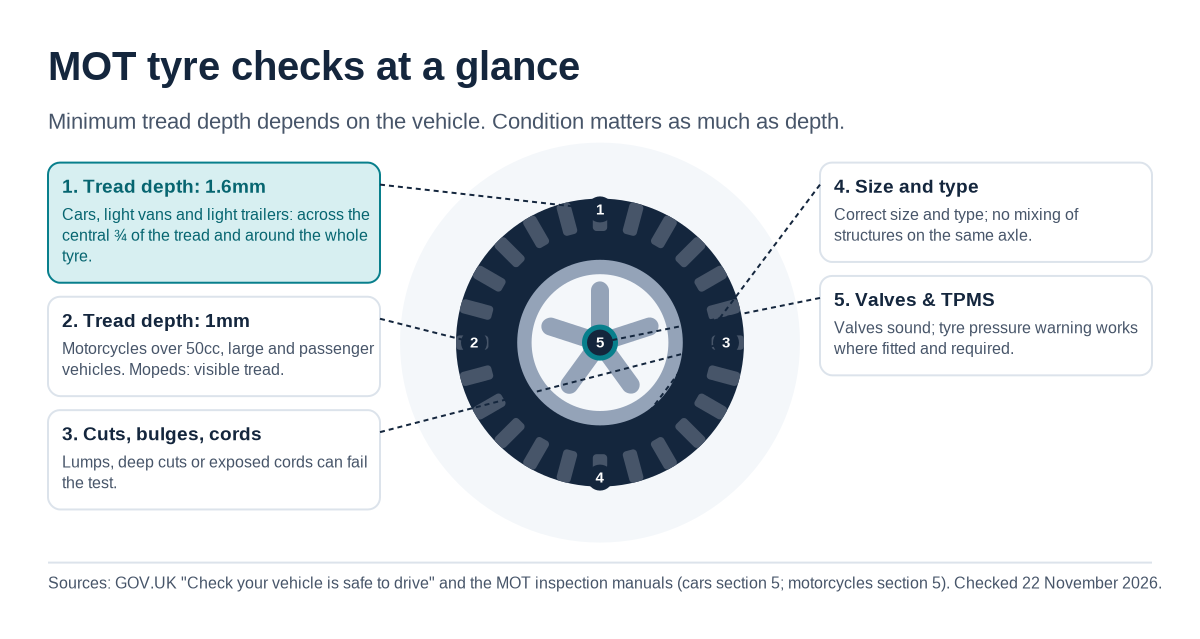

For cars, light vans and light trailers, tyres must have at least 1.6mm of tread across the central three-quarters of the tread and around the entire circumference. Motorcycles, large vehicles and passenger-carrying vehicles need at least 1mm; mopeds need only visible tread, according to GOV.UK. The MOT also checks for cuts, bulges, exposed cords, incorrect sizes and types, and faulty tyre pressure monitoring where it is required.
Legal tread depths

| Vehicle | Minimum tread depth | Where it is measured |
|---|---|---|
| Cars, light vans, light trailers | 1.6mm | Across the central three-quarters of the tread, around the whole tyre |
| Motorcycles over 50cc | 1mm | Across three-quarters of the breadth of tread, around the whole tyre |
| Mopeds (50cc or less) | Visible tread | Across the whole tread and around the tyre |
| Large vehicles and passenger-carrying vehicles | 1mm | As set out in the relevant manual |
The MOT manual explains that only the primary grooves count when measuring tread depth; shallower secondary grooves and sipes are ignored.
Damage and condition checks
A tyre can fail even with plenty of tread. Testers look for:
- cuts deep enough to reach the ply or cords;
- bulges, lumps or tears caused by impact or separation;
- exposed cords anywhere on the tyre;
- incorrect size or type for the vehicle, or mixing different structures on the same axle;
- damaged valves; and
- tyre pressure monitoring system (TPMS) warnings on vehicles where it is required.
Illegal tyres are not just an MOT issue. The police can deal with them at any time, so check your tyres regularly, not only before the test.
How to check your own tyres
- Look at the tread wear indicators. Most car tyres have small raised bars in the main grooves; when the tread is level with them, the tyre is at or near the limit.
- Use a tread depth gauge in several places across and around each tyre.
- Run a hand around the sidewalls (when the car is parked safely) to feel for bulges and cuts.
- Check pressures against the handbook or door-pillar label, with the tyres cold.
- Look at the wear pattern. Wear on one edge can point to alignment or suspension problems — see suspension and steering checks.
Tyre advisories
"Tyre worn close to legal limit" is one of the most common advisories. It means the tyre passed this time, but may not last until the next test. Use the advisory checker to see what was recorded, and read MOT advisories explained.
Related checks
Tyres, brakes and suspension work together, so problems in one often show in another. If a tyre has already caused a fail, see what happens if your car fails its MOT. Riders should also read the motorbike MOT checklist, and everyone can use our general pre-MOT checklist.
Questions people also ask
Is the spare tyre checked?
The MOT concentrates on the tyres in use on the road wheels. Your spare should still be legal if you ever fit it.
Is 2mm of tread enough to pass?
For a car, 2mm is above the 1.6mm minimum, so it can pass if the tyre is otherwise in good condition. A tester may record an advisory if the tread is close to the limit.
Sources
Facts in this guide were checked against these official pages on the dates shown. Rules can change; follow the links for the latest version.
- Check your vehicle is safe to drive (GOV.UK) — reviewed 22 November 2026
- MOT inspection manual: axles, wheels, tyres and suspension (GOV.UK) — reviewed 22 November 2026
- MOT inspection manual for motorcycles: wheels, tyres and suspension (GOV.UK) — reviewed 22 November 2026