The MOT checks both the condition of your brakes and how well they work. Testers inspect discs, drums, pads, shoes, callipers, pipes and hoses, and check warning lamps such as ABS. They also measure braking performance with test equipment. Problems range from minor issues to dangerous defects that mean the vehicle must not be driven until repaired.
What testers inspect
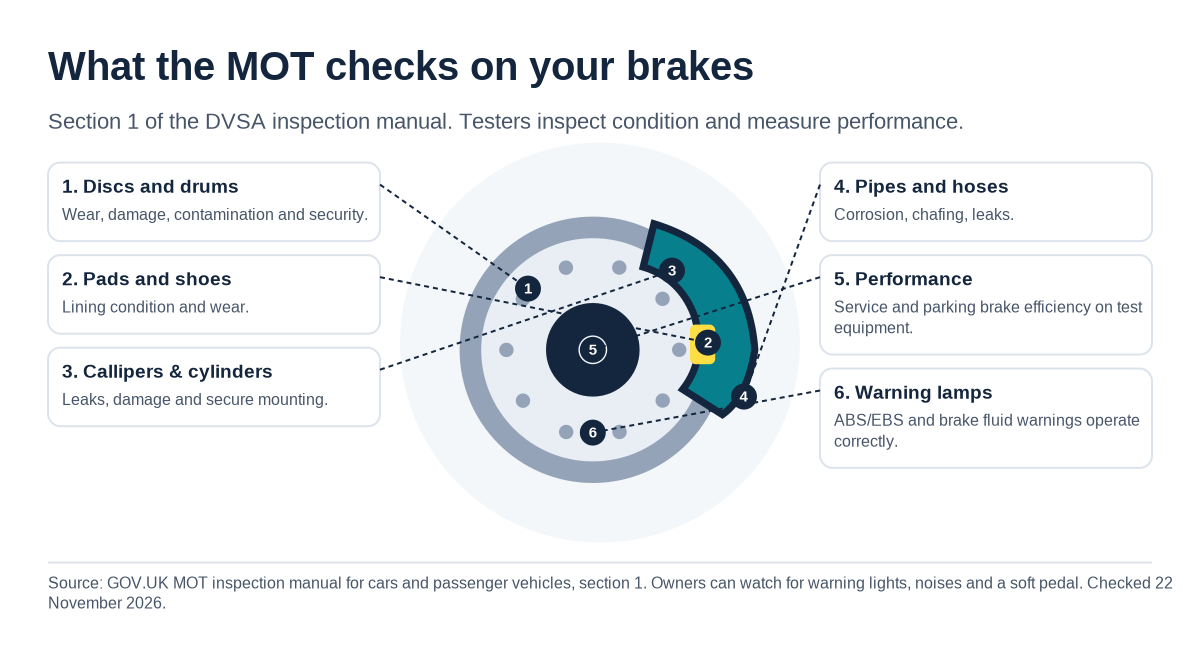
Section 1 of the DVSA inspection manual for cars covers braking. The main areas are shown below.

| Area | What is checked |
|---|---|
| Discs and drums | Wear, damage, contamination and security |
| Pads and shoes | Lining condition and thickness |
| Callipers and wheel cylinders | Leaks, damage, seized parts and secure mounting |
| Pipes and hoses | Corrosion, chafing, kinks and leaks |
| Pedal, lever and parking brake | Condition, travel and operation |
| Performance | Service brake and parking brake efficiency, and imbalance between wheels |
| Warning lamps | ABS, electronic stability and brake fluid warnings, where fitted |
For motorcycles, the brake section covers levers and pedal, linings and pads, callipers and cylinders, brake fluid and performance. See our motorbike MOT checklist.
How performance is tested
Most cars are tested on a roller brake tester, which measures the braking force at each wheel. Where that is not suitable, a tester can use a decelerometer during a short road test. The result is compared with the required efficiency for the vehicle's age and type, and the tester also looks for a significant imbalance between left and right.
Signs your brakes need attention
You can't measure efficiency at home, but you can notice warning signs:
- a brake or ABS warning light that stays on after starting;
- squealing, grinding or scraping when braking;
- the car pulling to one side under braking;
- a soft, spongy or sinking pedal;
- a parking brake that does not hold on a slope;
- fluid below the minimum mark in the reservoir.
GOV.UK says you can be fined up to £2,500, banned from driving and get 3 penalty points for driving a vehicle with a dangerous problem. Brake repairs should be done by someone competent.
Brake advisories
Testers often record advisories such as discs that are "worn, pitted or scored, but not seriously weakened", or pads wearing thin. These pass, but they are a clear sign that work is coming. Use the MOT advisory checker to see what was recorded last time, and read MOT advisories explained.
If the brakes fail the MOT
A major or dangerous brake defect means the vehicle fails. Whether you can drive it away depends on the defect category and your current certificate. See what happens if your car fails its MOT. Brakes are closely linked to tyres and suspension and steering, so it is worth checking those at the same time.
Before your next test, work through our MOT checklist.
Questions people also ask
Will a brake warning light on the dashboard fail the MOT?
A brake system warning lamp that indicates a fault can lead to a failure. Get it checked before the test.
Can a brake advisory become a dangerous defect?
Yes. Worn pads or a corroded pipe can deteriorate quickly. Advisories are a prompt to get the brakes checked, not a guarantee they will last a year.
Sources
Facts in this guide were checked against these official pages on the dates shown. Rules can change; follow the links for the latest version.
- MOT inspection manual: cars and passenger vehicles (GOV.UK) — reviewed 22 November 2026
- MOT inspection manual: motorcycles (GOV.UK) — reviewed 22 November 2026
- MOT test result (GOV.UK) — reviewed 22 November 2026