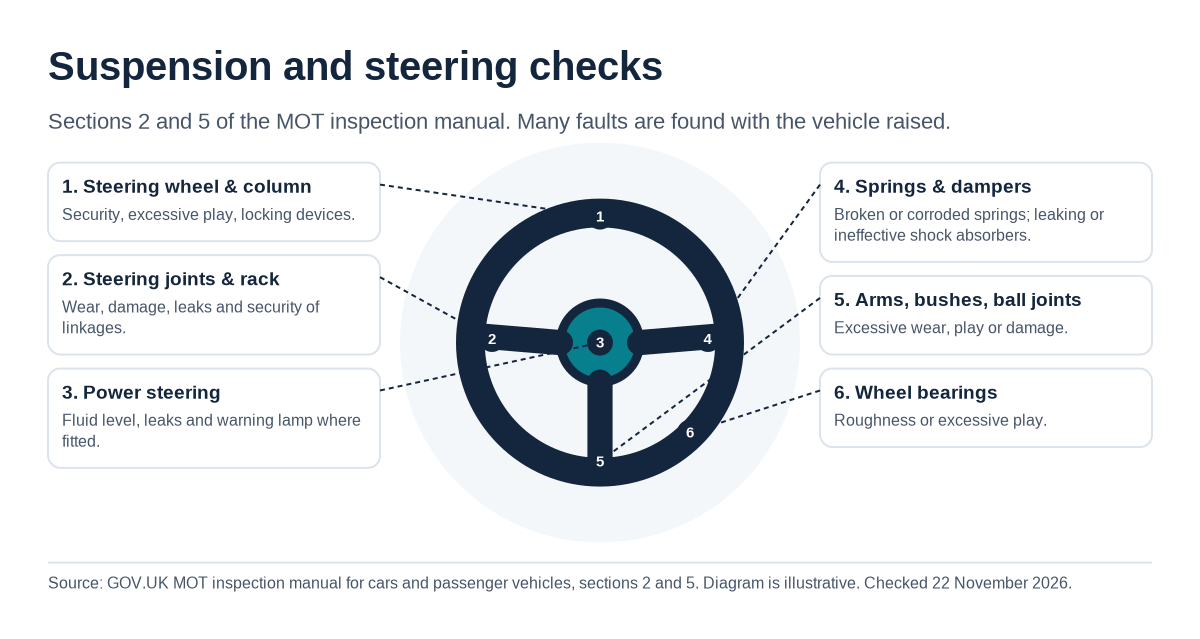

The MOT checks that the steering and suspension are secure, not excessively worn and working as they should. Testers inspect the steering wheel and column, steering joints and rack or box, power steering, springs, shock absorbers, suspension arms, bushes, ball joints and wheel bearings. Many faults are found with the vehicle raised, so they are hard to spot yourself — but some symptoms are easy to notice.
What testers inspect
Sections 2 (steering) and 5 (axles, wheels, tyres and suspension) of the DVSA manual cover these parts.

| Area | Typical defects |
|---|---|
| Steering wheel and column | Insecure wheel, excessive movement in the column, faulty locking device |
| Steering joints, rack and linkage | Excessive wear or play, damaged gaiters, insecure components |
| Power steering | Fluid leaks, low fluid, insecure pipes, warning lamp on where fitted |
| Springs | Fractured, broken or seriously corroded springs |
| Shock absorbers | Leaking, damaged or ineffective dampers |
| Suspension arms, bushes and ball joints | Excessive wear, play, corrosion or damage |
| Wheel bearings | Roughness or excessive play |
Symptoms to look out for
- Clunks or knocks over bumps can point to worn joints, bushes or a broken spring.
- Excessive bouncing after a bump can indicate worn shock absorbers.
- Wandering or vague steering may suggest worn joints or rack.
- Uneven tyre wear, especially on one edge — see MOT tyre checks.
- Heavy steering or a power steering warning lamp.
- A humming or grinding noise that changes with speed, which can be a wheel bearing.
- The car sitting lower at one corner.
Steering and suspension repairs are safety-critical and often need special tools and alignment equipment. A competent mechanic should carry them out.
Advisories for suspension and steering
Common advisories include a gaiter that is damaged but not yet allowing dirt in, slight play in a joint, or corrosion on a spring. These pass, but are worth having checked. Use the advisory checker to see what was recorded at the last test.
If it fails
A major or dangerous steering or suspension defect means a fail. Whether you can drive the vehicle away depends on the category and on your current certificate — see what happens if your car fails its MOT. Suspension and brake problems often show up together, and our MOT checklist lists simple checks to do before the next test.
Questions people also ask
Will a broken coil spring fail the MOT?
A fractured or broken spring is a common reason for an MOT failure. It can also affect handling and tyre wear, so it is worth repairing promptly.
Is a steering wheel that is off-centre an MOT failure?
An off-centre wheel on its own usually points to wheel alignment. The MOT focuses on condition and security, such as excessive play or worn joints, rather than alignment settings.
Sources
Facts in this guide were checked against these official pages on the dates shown. Rules can change; follow the links for the latest version.
- MOT inspection manual: cars and passenger vehicles (GOV.UK) — reviewed 22 November 2026
- MOT inspection manual: axles, wheels, tyres and suspension (GOV.UK) — reviewed 22 November 2026
- MOT test result (GOV.UK) — reviewed 22 November 2026